
South African organisations increasingly rely on the WhatsApp Business API to connect with customers, streamline service, and boost sales. Yet the Protection of Personal Information Act (POPIA) sets clear rules for how personal data must be handled, stored, and shared. Navigating these obligations alongside the technical and operational realities of WhatsApp Business API can be challenging.
This article explores common POPIA compliance hurdles faced by organisations using WhatsApp Business API in South Africa. We explain practical ways to meet consent requirements, manage data securely, and reduce risk while maintaining a smooth customer experience.
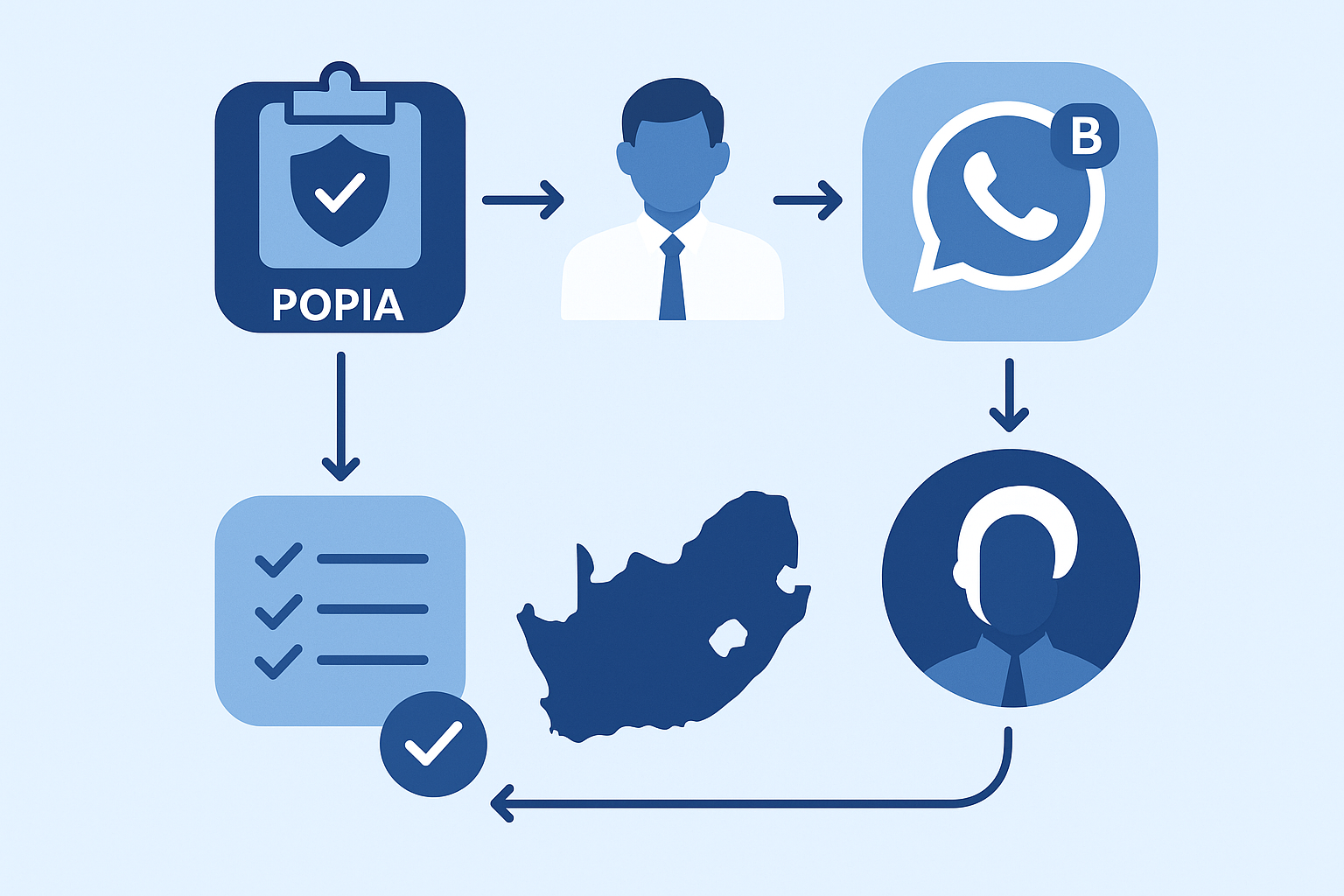
Understanding the Intersection of WhatsApp Business API and POPIA
POPIA aims to protect personal information by requiring organisations to collect, process, and store data responsibly. WhatsApp Business API enables conversations that often involve personal data such as names, contact numbers, payment details, and behavioural insights.
While WhatsApp itself uses end-to-end encryption, compliance responsibility lies with your organisation. This includes obtaining valid consent before messaging, securing data post-collection, and ensuring lawful processing throughout.
Many South African businesses underestimate the operational shifts needed to align WhatsApp communications with POPIA - especially when scaling across teams and integrating with CRM or ERP systems.
Consent Management: The Foundation of POPIA Compliance
Obtaining and managing consent is the most critical POPIA aspect when using WhatsApp Business API. The law requires consent to be:
- Informed: Customers must understand what data is collected and how it will be used.
- Specific: Consent should cover particular purposes, such as marketing or support.
- Voluntary: Customers cannot be forced or misled into consenting.
- Recorded: Your organisation must capture and store consent evidence securely.
Many companies struggle with tracking consent when conversations start on WhatsApp and then shift to other channels or internal systems.
Best practices for consent capture with WhatsApp Business API
Use automated workflows to deliver clear consent requests as message templates before engaging in substantive communication. Integrate consent records with your CRM to track each customer’s status in real time. Periodically refresh consent to remain compliant with evolving preferences.
Where possible, avoid bulk messaging to unverified contacts. Instead, initiate contact with opt-in campaigns or direct requests through other channels.
Data Security and Storage Considerations
POPIA mandates reasonable security safeguards to prevent data breaches while personal information is in your control. This includes WhatsApp message content stored on your servers or third-party platforms.
WhatsApp Business API conversations often integrate with CRM or ERP systems, which adds complexity to data flows and storage locations. Organisations must carefully assess where data resides and who can access it.
| Storage Option | Pros | Cons | POPIA Considerations |
|---|---|---|---|
| On-premise servers | Full control, easier audits | Higher cost, complex scalability | Must implement strong physical and digital security measures |
| Cloud-based platforms | Scalable, lower upfront cost | Dependence on provider security, potential cross-border data flow | Ensure provider complies with POPIA and data localisation requirements |
| Hybrid solutions | Balance control and flexibility | Complex integration, requires clear policies | Clear data classification and controls needed to avoid breaches |
Encryption plays a vital role but cannot replace robust access control, monitoring, and employee training. Your compliance strategy must extend beyond the WhatsApp platform to every system that handles personal data.
Balancing Customer Experience and POPIA Requirements
Strict compliance sometimes feels at odds with delivering fast, personalised service. For example, requiring explicit consent before every new message thread may slow down interactions.
Here, automation and workflow design come to the fore. You can configure automated consent prompts that fit naturally into onboarding or recurring communications. Using message templates approved by WhatsApp also helps ensure transparency and consistency.
"Consent management and data security are not just legal checkboxes - they build customer trust and protect your brand reputation."
South African organisations should also be mindful of POPIA’s breach notification timelines. Detecting and responding quickly to incidents involving WhatsApp communications requires integrated monitoring and reporting tools.
When to Consult Legal and Technical Specialists
POPIA compliance for WhatsApp Business API is not a one-off project. It demands continuous review as laws, platforms, and business models evolve.
Particularly for larger organisations or those in regulated sectors like financial services, healthcare, or telecommunications, legal advice ensures consent frameworks and data processing policies meet all obligations.
Technical input is equally important to architect secure integrations and audit-ready data flows. This includes choosing trusted partners like Answer who understand the South African context and can assist with compliance-aligned WhatsApp Business API deployments.
Key takeaway. Balancing POPIA compliance with effective WhatsApp Business API use requires clear consent management, secure data handling, and ongoing governance. Getting this right protects your customers and your organisation’s reputation.
If you are considering or already using WhatsApp Business API for customer engagement, it pays to evaluate your POPIA compliance approach carefully. Contact Answer to discuss tailored solutions that meet your operational needs and data protection obligations in South Africa.