
Picture your customer service team juggling multiple platforms at once: WhatsApp messages popping up on phones, emails flooding inboxes, and SMS updates sent from a separate system. In a market like South Africa, where customers expect quick, personalised responses, this fragmented approach can quickly lead to missed messages, duplicated work, and frustrated clients.
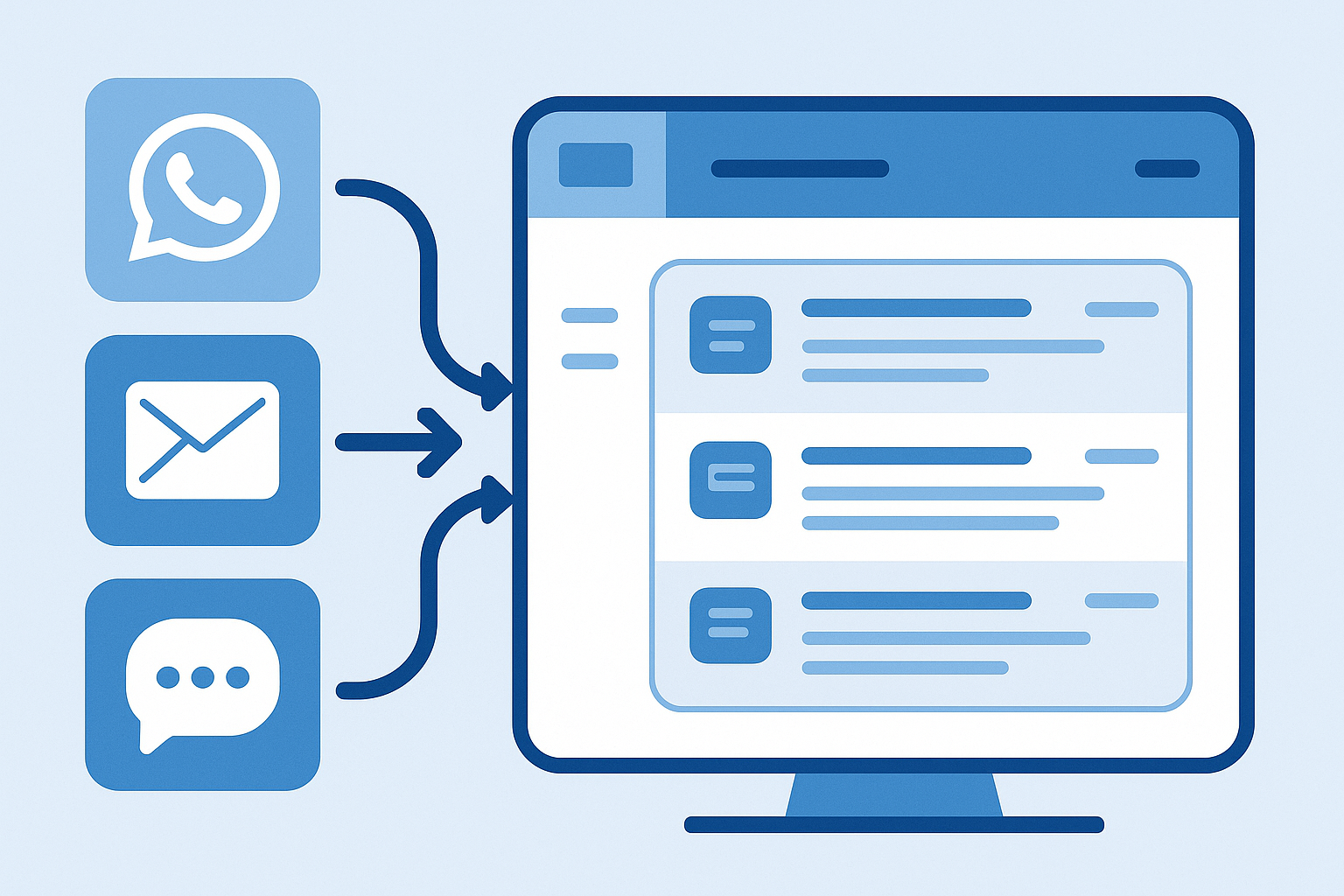
That’s why many South African organisations are turning to a unified inbox to manage WhatsApp, email, and SMS channels collectively. Pulling all customer conversations into a single interface changes how teams work and how service is delivered.
Why Managing Channels Separately Drains Resources
Many organisations initially handle WhatsApp, email, and SMS as distinct channels. It might seem straightforward to assign separate teams or apps to each. Yet this approach often causes operational headaches:
- Siloed information: Customer history can get scattered across platforms, making it hard to get a complete picture.
- Duplicated effort: Agents may respond to the same customer question multiple times or switch between tools to gather context.
- Slow response times: Switching between apps eats up time and disrupts workflow.
- Inconsistent customer experience: Messages from the same customer might be handled differently depending on the channel.
South African companies, especially those dealing with high volumes of enquiries in sectors like retail, finance, and telecommunications, find these problems increasingly acute as they scale.
How a Unified Inbox Streamlines Customer Communication
A unified inbox aggregates WhatsApp, email, and SMS messages into one platform where agents can see and reply to all conversations. This integration is more than just convenience; it fundamentally reshapes daily operations.
Here’s what a unified inbox can deliver:
- Single view of customer interactions: Agents access complete conversation histories regardless of channel, improving context and personalisation.
- Faster response times: No need to toggle between separate apps means agents can reply quickly and efficiently.
- Simplified workload management: Supervisors can assign and track enquiries across channels from one dashboard.
- Consistent service quality: Templates and workflows apply uniformly across WhatsApp, email, and SMS.
- Improved compliance: Centralised records help meet POPIA requirements for data handling and consent.
Comparing Separate vs Unified Channel Management
| Aspect | Managing Channels Separately | Using a Unified Inbox |
|---|---|---|
| Customer History | Scattered across apps, hard to retrieve quickly | Consolidated in one place for full context |
| Agent Efficiency | Time lost switching between tools and platforms | Streamlined workflow with all messages visible in one interface |
| Response Times | Slower due to fragmented notifications | Faster due to unified notifications and prioritisation |
| Compliance with POPIA | Harder to ensure consistent logging and consent handling | Better centralised records and audit trails |
| Scalability | Requires more tools and manual coordination as volume grows | Scales smoothly with automation and integration options |
Addressing South African Compliance and Consent Challenges
Managing multiple communication channels separately complicates compliance with POPIA, South Africa’s data protection law. Tracking customer consent, retention of records, and secure data handling can become fragmented.
A unified inbox centralises consent management and message archiving, making it easier to audit interactions and prove compliance. For example, if a customer revokes consent or requests deletion, the organisation can find and act on all related communications quickly.
Technology Considerations for Implementation
Choosing the right platform to unify WhatsApp, email, and SMS requires a clear understanding of your team’s workflows, integration needs, and capacity for change.
Technical factors to evaluate before adopting a unified inbox
- WhatsApp Business API integration: Not all platforms support full API access, which enables automation and CRM linking.
- CRM and ERP connectivity: Seamless integration with existing systems ensures customer data flows smoothly.
- Automation capabilities: Chatbots and workflow rules can reduce repetitive tasks and speed up responses.
- User interface: The platform should be intuitive to minimise training time and errors.
- Data security and hosting: Prefer solutions that comply with POPIA and local data residency preferences.
Practical Benefits Observed by South African Teams
Consider a Johannesburg-based retailer handling thousands of WhatsApp enquiries daily, alongside email orders and SMS promotions. After adopting a unified inbox:
- Customer service agents reduced average response times by 30%
- Escalations dropped because issues were resolved faster with full context
- Supervisors allocated workload dynamically across agents regardless of message origin
- Compliance officers found it easier to monitor consent and data handling
Key takeaway. While managing WhatsApp, email, and SMS separately might seem manageable at first, scaling your customer communication demands a unified inbox. It improves efficiency, consistency, and compliance-critical factors in South Africa’s competitive and regulated business environment.
Common Misconceptions About Unified Inboxes
- Unified inbox means losing channel-specific features
- Not necessarily. Good platforms maintain key WhatsApp capabilities like message templates and read receipts alongside email threading and SMS delivery reports.
- Implementation is too complex for most teams
- With partners like Answer, integration can be phased and supported to reduce disruption.
- Unified inboxes remove personal touch
- On the contrary, having full context lets agents personalise responses more effectively.
Getting Started with a Unified Inbox at Your Organisation
Moving to a unified inbox begins with understanding your current communication flow and pain points. Engage stakeholders across customer service, IT, compliance, and sales to map requirements.
Next, evaluate platforms with proven WhatsApp Business API integration and local support in South Africa. Consider a phased rollout starting with high-volume channels.
Training and change management are equally important. Teams must be confident navigating the new interface and adhering to updated workflows.
Answer specialises in delivering unified inbox solutions tailored for South African organisations, integrating WhatsApp, email, and SMS with CRM and workflow automation.
If your team is ready to reduce complexity and improve customer communication, contact Answer to discuss how a unified inbox can fit your business.